Axis 1-
Machine learning assisted quantum chemistry simulation for heterogeneous catalysis
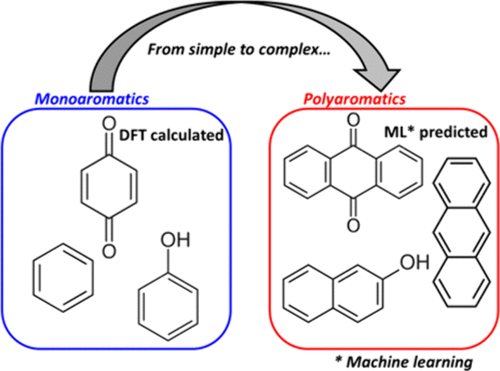
Quantum-chemistry calculations are time-consuming and computationally demanding. As a result, methods such as density functional theory (DFT) can be challenging to apply to large systems (typically >150 atoms). This constraint is a major bottleneck in bridging computation and experiment, as realistic catalytic models often require substantially larger system sizes (at least 104–105 atoms). At SimNanoCat, we develop machine-learning (ML) approaches to address these challenges and accelerate the prediction of the properties and reactivity of heterogeneous catalysts. Below is a case study on rapid prediction of polyaromatic reactivity on bimetallic surfaces using a descriptor-based approach.
- Jérémie Zaffran,* Minyang Jiao, Raphaël Wischert, Stéphane Streiff and Sébastien Paul «Upgrading the density functional theory with machine learning for the fast prediction of polyaromatic reactivity at bimetallic catalysts», The Journal of Physical Chemistry C, 2024, 128, 5084–5092
Axis 2-
Surface reactivity investigation and solid catalyst design by quantum chemistry simulation
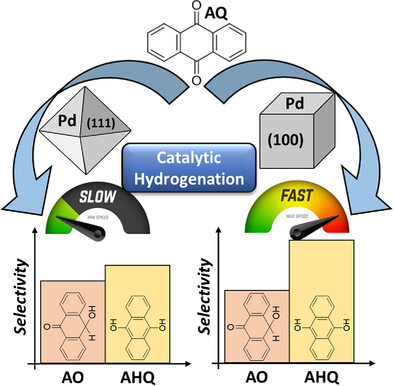
Atomistic simulations are particularly well suited to rationalizing surface reactivity at the nanoscale and provide key insights for designing efficient catalysts. At SimNanoCat, we use these computational tools, in particular DFT and microkinetic modelling, to elucidate reaction mechanisms in complex chemical processes and to design innovative catalytic systems for a wide range of applications. Below is a case study that rationalizes surface reactivity in Pd-catalyzed anthraquinone (AQ) hydrogenation as a function of nanoparticle shape and size.
- Jeremie Zaffran,* Jing Yu, Sebastien Paul and Qingyi Gu « Investigating the Effect of Morphology on Nanoparticle Catalyst Reactivity: Example of Anthraquinone Hydrogenation » ChemCatChem, 2025, 17, e202500093
Axis 3-
Sustainable Process Development: Combining Computational and Experimental Chemistry
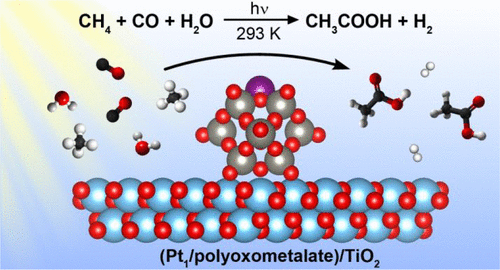
Computational chemistry insights can be decisive for interpreting experimental results and supporting the development of chemical processes across a wide range of applications. At SimNanoCat, we work hand in hand with our experimental partners to identify sustainable routes for producing value-added products of industrial relevance from syngas, waste CO₂, biomass-derived feedstocks, and other carbon-based species. Below is a case study bridging experiment and computation in the design of efficient TiO₂-supported polyoxometalate (POM) photocatalysts for methane carbonylation to acetic acid.
- Chunyang Dong, Maya Marinova, Karima Ben Tayeb, Olga V. Safonova, Yong ZhouDi Hu, Sergei Chernyak, Massimo Corda, Jérémie Zaffran, Andrei Y. Khodakov* and Vitaly Ordomsky* «Direct Photocatalytic Synthesis of Acetic Acid from Methane and CO at Ambient Temperature Using Water as Oxidant» Journal of the American Chemical Society, 2023, 145, 1185–1193